

Opening the Circle
Introducing the AGECRAFT After Dark Questionnaire - I'll Go First

🕯️ Greetings from the liminal!
Once or twice a month, guest writers will be contributing to AGECRAFT After Dark by answering the AGECRAFT After Dark Questionnaire, found here. It’s a simple, slightly mischievous framework designed to make writing here feel approachable and less perfectionistic, and more…see what happens if you follow the thread.
The questionnaire isn’t just for the writers, though, it’s for the readers too. The questions are meant to spark that quiet click of recognition, the “oh… same, SAME” moment, or to send you wandering into your own thoughts long after you close the tab. The goal isn’t answers or agreement. It’s resonance. Aging, identity, and becoming are collective experiences, even when they feel deeply personal.
That said, it felt only right to go first.
Before inviting other voices into this space, I wanted to answer the same questions I’ll be asking of them (maybe you?). Partly as a warm-up, partly as a proof of concept (for sure), and partly because I don’t want y’all to think I’m hiding. If I’m asking others to wander into the liminal, the slightly feral and the spooky… I can do that too.
So consider this both an introduction and an offering. I’ll start!
Julia Granacki answers the AGECRAFT After Dark questionnaire!
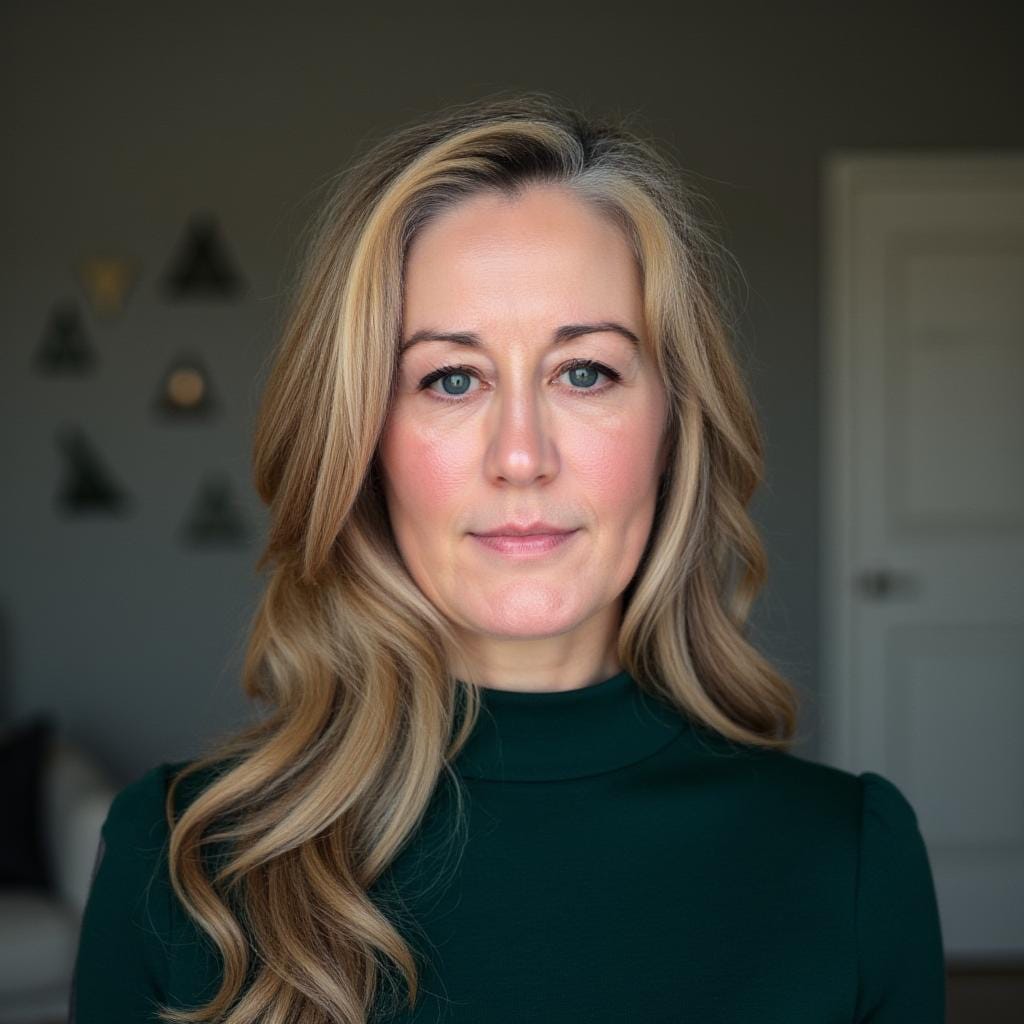
Name: Julia Granacki
Pronouns: She/Her
Age: 50
Julia Granacki is a board-certified health and wellness coach (NBC-HWC) and Pilates instructor helping people navigate midlife as initiation, not decline. Through AGECRAFT, she blends evidence-based behavioral change practices with ritual, symbolism, and sharp cultural insight. Her work centers bodies that refuse to disappear—across genders and identities—and invites clients to craft lives that can hold what emerges, especially in the liminal space of aging and identity shifts.
Please answer the following (each answer should be no more than 200 words):
1) What’s currently keeping you up at night (existential dread, grocery lists, life epiphanies, imaginary arguments, or all of the above…)? My husband’s snoring. Specifically at 3 a.m. It is truly breathtaking how I can love and adore a person with every fiber of my being while simultaneously fantasizing about smothering them with a pillow. Marriage is an enigma.
Beyond that—night terrors, sleep paralysis, and the occasional shadow person (this will absolutely be covered in another post, I promise). And, of course, my own crippling self-doubt, courtesy of my overly industrious, deeply unhelpful inner critic, whom I lovingly refer to as The A**hole. She specializes in replaying every embarrassing, mean, or questionable thing I’ve done since approximately age eight.
She is deeply committed to this work! Especially dragging me back to that fifth grade pool party where I took my shirt off, forgetting I’d already removed my swimsuit top underneath. “T*ts out” is an overstatement, biologically speaking, given I was a prepubescent. BUT. It was still enough to fuel hallway gossip for months.
The A**hole remembers everything.
2)What valuable lessons have you learned and unlearned from your ancestors? (Family, cultural, chosen, or imagined.) From both my actual family and my chosen family, I learned what real resilience looks like. Not the Instagram-performative version, but the kind forged through tragedy, death, breakups, lost jobs, and lives that didn’t turn out the way anyone planned. Knowing what the people around me have survived reminds me, again and again, that I can survive the hard parts too.
I learned the magick of making things from my mother and both of my grandmothers. Crocheting, sewing, creating music, and writing poetry. Creation was how feelings, history, and love moved through our family. In my Eastern European family, it certainly wasn’t through open communication!
After my maternal grandmother passed, we discovered poems she had written and never shared. I have one she wrote about World War II hanging on my wall. There a few lines crossed out and rewritten. Totally imperfect and exactly PERFECT. It’s a quiet inheritance and proof that creativity survives us and waits to be found.
I had to unlearn the idea that the job paying your bills is allowed to make you miserable—that suffering was somehow a part of being responsible. I’ve since replaced that belief with the understanding that I can earn a living doing work that actually lights me up.
I also had to unlearn my inherited Eastern European stoicism. The reflex to stay silent, swallow feelings, and call that strength. Becoming softer, more communicative, and more emotionally available has been its own kind of resilience.
And finally, I had to unlearn the story that marriage is a state of quiet misery. I’ve learned instead that it’s possible to fall deeply in love and build real friendship and respect with the person you choose to share your life with.
This is what I’ve learned to keep and what I’ve learned to release. Resilience without martyrdom, love without misery and work without punishment. Now, I’m crafting a life with enough intention to hold what comes next.
3)Where are you in the liminal space of age and/or identity right now? As an ally, I’ve always understood gender and sexuality as a spectrum, in theory. In practice, I somehow assumed this was important work for society at large and not, you know, something that applied directly to me.
And yet, over the last five years or so I’ve had the very clear realization that if I were suddenly back in the dating world (I am not, calm down), I would absolutely date people who identify as transmasc. This discovery arrived quietly and without drama.
I’m fairly certain Mae Martin (via Wayward and The Handsome Podcast)was my “oh, interesting” moment. I’m not rushing to label this realization, because I’m in my fifties and I’m tired. BUT. It did clarify something—my sexuality is more fluid than I previously gave it credit for.
Important clarification: I am deeply happy, satisfied, and very much in love in my marriage. No structures are being dismantled and no dramatic announcements are forthcoming. This is simply an observation. A quiet expansion of self-awareness that showed up in midlife like, Surprise! You still get to learn things about yourself!
Which, frankly, feels like the most liminal thing of all.
From the eight questions below, select and answer FIVE (each answer should be no more than 200 words):
1)If you were a ghost, who would you haunt—and how would you let your presence be known (Smoke, rattling chains, moving furniture)? I’ve always loved a good jump scare, so this would be my vibe! First, I’d haunt my husband and then my friends. For my husband, I’d manifest as disembodied snoring in the middle of the nigh. If you read question #1, you know this is cosmic justice. For my friends, I’d pop up in the bathroom mirror while they’re brushing their teeth and then immediately disappear. No explanation. Just to make them jump!
That said, if I’m being honest, I’d be a truly terrible ghost.
If you know me at all, you know my memory is trash. I once got into a full-on argument with a friend who insisted I was in our college production of A Funny Thing Happened on the Way to the Forum. I told her she was 100% wrong only to receive a shaky video twenty minutes later of me doing a very underwhelming dance in said production. Apparently, I blocked it out. Along with… a lot of other things.
Half the time, I can’t even remember why I walked into the next room.
So while I aspire to be the creepy snore or the fading apparition in the mirror, the reality is I’d probably float into someone’s house, forget who I was haunting and why, knock something over, panic, and then spend eternity trying to remember what I came there to do in the first place.
So. If you notice objects slightly out of place and a vague sense that something almost happened, that’s probably me!
2)What’s a place, habit, or moment that reliably feels a little bit enchanted to you? PASS
3)What did you believe you were “running out of time” for—and how do you see that differently now? PASS
4)What are you learning to live alongside, rather than change or “fix”? I was diagnosed with ADHD in my early forties. And because the term gets tossed around like confetti these days, I’ll clarify—this was not a self-diagnosis. I was formally tested and diagnosed by both a therapist and a psychologist.
Finding out I was neurodivergent in midlife was equal parts mind-blowing, vindicating, and quietly heartbreaking. Suddenly, decades of behavior (especially in my twenties) made sense. The reactivity! The paralyzing overwhelm and the ways I moved through the world that felt peculiar or off-putting, leaving me convinced that something was fundamentally wrong with me. I spent years treating those traits as personal failures, as brokenness I just needed to try harder to fix.
Naming the thing changes everything. Had I known earlier, I could have pursued treatment, but more importantly, I could have offered myself grace instead of shame.
Now, I don’t see my neurodivergence as something to fix. I see it as a superpower. One that requires training, boundaries, and personal responsibility. I have to know my triggers, protect my rest, use my CBT tools, and, yes, take my meds.
And when The A**hole inevitably shows up in the middle of the night to remind me of past missteps or perceived failures, I’m learning not to argue with her or believe her. I acknowledge her presence and tell her to f*ck right off.
5)When/Where have you (quietly or loudly-both count) refused the script you were handed? When I turned 40, I found myself six years into a C-suite executive assistant role and having a very real, very unglamorous midlife crisis. I was good at my job. I was miserable in my job. And I knew I needed to quit but I just had absolutely no idea what I was quitting to.
So I did what many anxious, capable women do. I collected credentials. I got my Pilates mat certification and enrolled in the dietetics program at Hunter College because I thought I wanted to be a nutritionist. On paper, it all looked very responsible.
In reality, that degree would’ve taken years (while working full-time) and cost roughly the same as a small house. Then life stepped in. An engagement, a death in my immediate family, and those plans fell apart completely. Which in hindsight, was revealing. Maybe they weren’t the right plans to begin with.
Around that time, a colleague I genuinely like said to me, half-jokingly, “Oh, you’re not going anywhere. You’re so good at this. You’re a lifer. You’ll never do anything else.”
They didn’t mean it as an insult. But. If there’s one thing to know about me, it’s that nothing motivates me quite like being told my story is already written.
I didn’t leave immediately. In fact, it took another six years, but I did leave. I did change my life. And refusing that script—even slowly, even quietly—turned out to be one of the best decisions I’ve ever made.
6)What brings you power, pleasure, or joy that once felt impractical, indulgent, or “too much”? PASS
7)What bodily investment do you spend time or money on that others might call “vain,” but you know is actually about visibility, ritual and power? I make no apologies for caring about how I look. I get Botox (When I can afford it!). I use all the lotions and potions. I highlight my hair, keep my nails shellacked with chemicals that will probably rot my fingers off, and own an unreasonable amount of makeup, especially colored eyeliner, which feels both joyful and mildly financially irresponsible.
I’m 50 and in the best shape of my life, and yes, I dress to show off the work I’ve been putting in at the gym and in the Pilates studio. Not because I’m chasing youth, but because I earned this body. That’s not vanity, that’s pride, and pride for women in midlife is a form of power.
This is about visibility. About refusing to quietly fade into the background just because the culture gets weird about aging women taking up space. Looking good to yourself can be ritual. It can be armor. It can be a reminder that you’re still here and still allowed to enjoy being seen.
I fully support whatever power and pride look like for every BODY. I tell my Pilates clients all the time—I don’t build skinny bodies, I build strong ones. Strength and power come in many forms.
Yes, it’s important to stay aware of what the patriarchy and culture try to sell us about beauty and worth, but at the end of the day, it’s your body. You’re the one who has to look at yourself in the mirror and that reflection should feel GOOD at any stage, at any age and at any weight.
Whether you go gray, get your skin lasered off, wear lipstick, or don’t. Own it. Love it. Let it flow from you as power.
8)Here at AGECRAFT After Dark, we view aging as initiation and empowerment—but let’s be honest it’s not all glow-ups. What part of aging genuinely sucks for you right now?
My eyesight, or lack thereof.
Being both near- and far-sighted is a special kind of baneful magick. I’m currently wearing one progressive lens in one eye, which means I can sort of see most of the time.
Allegedly, this is “the best we can do.” At least until I can get robot eyeballs.
It is not great.
It is, in fact, deeply annoying.
You are such a good writer with an absolutely clear voice that’s authentically you. I deeply appreciate your vulnerability, humor and unapologetic pride in how you care for yourself. That trait has always been aspirational for me. You’re the coolest.
I’m going to respond briefly and then again a bit more. Lots to process and finding many similarities between your thoughts and my own. Deeply appreciate and admire your candidness. I will try my best to be as open and honest in my own responses. Most grateful 🙏🏻💖💫🌀